Sunday, February 17, 2019

Machines and rosettes


I have an uneasy relationship with woodworking machines. I know they will do things quickly and they will reliably repeat operations. That is, once you get them set up. Often I can make a cut more quickly with a hand saw than I can with the table saw. I admit that's partly because the table saw is often covered with stuff. It's a horizontal surface and that's what tends to happen to every horizontal surface in my shop. Aside from that, if the piece is short or thin it's safer to cut it with a hand saw.

I have a well-equipped shop and I use some of the machines often. The band saw gets a lot of use and the table saw gets quite a bit if I'm cutting up panels or making repetitive cuts. I like my battery-powered drill/drivers. On the other hand, the bench top jointer hardly ever gets taken out. I prefer to use a hand plane and I'm reluctant to use the planer although I did have to admit defeat when I was making a couple of end-grain cutting boards and was faced with the task of surfacing them with hand planes.

My first wooden rosette
I've been wrestling with the old dilemma again this past week. My ukulele journey involves learning how to make rosettes to decorate the sound holes of instruments. Most folks use a router to cut the ring in the top into which the rosette gets inlaid. It's efficient; it's accurate. Jake has a Dremel tool with a router base and a circle cutting jig. I can learn to use his. I find myself resisting. Routers freak me out a bit. They're noisy and those bits spin so fast. If I don't get the bit in right... If I'm honest there's more to it than fear and worry about safety. I'm enamoured with the idea of being able to accomplish most woodworking tasks with a relatively simple set of hand tools. Of course, people who can do this started when they were in their teens and I don't have 30 or 40 years to perfect the skills. Still, it's an idea that won't let go of me. I don't have to make my living through my craft and it really doesn't matter how quickly or how slowly I get things done. So for the last 5 days I've been in the shop trying to create a manual circle cutting jig. 
This didn't work

I need a compass, or something like it, with a cutting blade. I need a way to keep the point from moving and a way to keep the cutter from shifting while I'm rotating it around the centre point. I thought I had a way that would work: take a wooden beam, attach a cutter to the end of it and put a track in the beam that allows the pin to move back and forth to change the size of the circle. Simple enough. Well, not really. I screwed the blade onto the end of the beam and broke the blade. Not one to give up, I laminated the part of the blade that was left between two thin pieces of wood and screwed that to the beam. How to get the point to stay put? I haven't figured that one out yet, at least not on the original design. I tried pinching the arms together with a screw – not tight enough. I tried a few other things as well and gained a new appreciation of Thomas Edison who learned hundreds of ways that didn't work to make a light bulb. Next I tried using a bolt as a centre and drilling a hole in a board to accept the bolt. The top would have a corresponding hole in it that would slip over the shaft of the bolt so I could rotate the cutter. This is the system Jake uses with his router. The drill bits I have are either too big, there is slop in the pin, or too small I have to thread the bolt into the hole in the wood and that means it won't turn freely.

This worked
After some checking on lutherie forums, I came across the suggestion to use a 'lolly' stick and an X-acto blade. I grabbed a tongue depressor (yes I have a bunch around left over from some craft project or other at school) and carefully poked a hole in it with a push pin. On the opposite end I cut a slit just big enough to take the point of an X-acto knife blade. I stuck the pin into a piece of wood, held the X-acto knife in place and scribed a perfect circle. Sometimes the simplest solutions are the best.

I'm still not satisfied. I want something a little more robust than that although with a collection of sharp blades it would do the job just fine. I have a small router plane that I can use to hog out the waste in the ring once the outer lines are established. I embarked on another internet search and found a few more possibilities. The one I'm working on at the moment involves holding the blade in place in a mortise with a wedge and sinking the centre pin into a piece of wood which will fit into an elongated mortise. The plan is to hold the centre pin in place with a bolt, nut and washer. It should work.

This may work
I decided that rather than cut the mortises I would cut the beam in half, cut one side of the mortise into each half and then glue the halves together. The first time I tried it I cut the mortises correctly in one piece and upside down in the opposite piece. I've got them correctly cut in the one I'm working on now. I used the bandsaw to cut the beam and then to rip it in half. The mortises themselves I've marked with a knife and cut with a chisel. It's taken me hours where it would have taken minutes with a router or even with a drill press. I have thoroughly enjoyed marking, chopping and paring while listening to my current who-dun-it. I don't know if this one will ultimately work or not but I know there are a few more hours of enjoyment to be had in trying to get it to work. I also know that as I struggle with the task my skill level increases and, as I said earlier, I don't have to make a living with the work of my hands. If I get really fed up I can use the router or I can give the 'lolly' stick and push-pin contraption another go. If that one breaks it's easy enough to get replacement parts. I'll let you know how the ring for the rosette in Richard's ukulele eventually gets cut. Stay tuned.


Sunday, February 10, 2019

Ukulele #1

Ukulele #1

Building a ukulele is a complicated process. Perhaps I should say “complex.” That sounds better but I think 'complicated' is more accurate in my case. Like many projects, on the surface it looks straightforward enough: a sort of figure 8 shaped box with a stick in one end. The trick is that the box has to look good and sound good, according to a standard western musical scale. That's where my old nemesis accuracy comes in. Is it straight? Well, it's sort of straight. Is it square? Sort of. Better get it right in the first place because the error just gets compounded the further into the build you get. Too many times to count Jake tidied up, tweaked or downright fixed what I had done. 

Sanding the sides
I learned a ton. You can translate that as I made a ton of mistakes but, as I always told my students, the only serious mistake is one from which you learn nothing. I can even claim to have made the same mistake several times in a row but eventually I ended up with a list of mistakes I won't make again. The good news is that there are countless mistakes that I haven't made yet so there's still good reason to make a few more instruments. Someone asked me the other day if I still needed help to build an instrument now that I've built one. She seemed surprised when I told her I didn't think I'd be able to build one on my own for quite a long time.

The first one is partly about learning what to pay attention to. The short answer to that is – everything! I did get some photos along the way but not nearly enough. In some ways my inelegant drawings are more helpful than photos. If I draw something I have to process it. If I take a photo sometimes I look at it and wonder why I took it. There's one photo of some masking tape on the inside of the back of the instrument. I remember Jake telling me not to stretch the tape as I put it on and I can't remember why I was putting the tape on in the first place. I think it was to do with lining up the back strip.

Clamping up the fretboard
There are many many small details that get absorbed through practice. Doing something once doesn't count as practice. I'm building two ukuleles instead of one so I can get in a wee bit more practice with each step. I'm hoping that on these two I'll be able to up my game by making smaller and different mistakes. I'm also hoping that by the time these two are finished I'll have fewer absolute blank spots in the process. It's an adventure and I'll be trying out some new things as I go.

The 3:00 a.m. rosette
At the moment I'm at work on two rosettes. The rosette is the decorative circle that goes around the sound hole in the top of a guitar or ukulele. A ukulele doesn't need a rosette and my first uke doesn't have one. Now I'm ready to give it a go. One rosette was partially made for me and one I'm making myself. A couple of days ago I got so involved with what I was doing that I didn't want to stop, and because I'm retired and don't always have to be responsible, I stayed up until 3:00 a.m. so I could see the wooden rosette mostly finished. I'm quite pleased with it so far and absolutely delighted with how much fun I'm having with it. I'm looking forward to a lot more fun on these builds. I know there will be times when I'm ready to take an axe to the whole project and I also know that if I walk away and do something else for a while I'll eventually be ready to get back into the shop and sort it out. Perhaps this time I'll be able to step back enough to invite you along for parts of the journey. Stay tuned.


Jake clamping the bridge on ukulele #1


Wednesday, January 9, 2019

I want my glasses back


 I know some of you will think I'm nuts but I'm kind of used to that. I had cataracts removed from both eyes in September and November of 2018. The results were truly amazing. The first morning I looked over at a sweater that had a black and white pattern on it with the eye that had the new lens. The sweater looked really white. I checked with the other eye. The sweater looked really yellow. Also the edges of things are now much sharper. Other than irritated eyeballs and drops every half hour for a week, the eyes are great.
     I, however, am not so good at navigating the world without lenses in front of my face. I have worn glasses for 60 years and not having them makes me quite uncomfortable. When I had the first eye done I could still wear my old prescription. When I had the second eye done my old prescription just made me seasick but I still need glasses to read. Off to the drug store for a package of 3. That solved the reading problem but what about when I'm in choir and I want to be able to read the music and see the conductor? I routed through the old glasses that I haven't yet given away, mostly because I like the frames, and I found a pair of bifocals that work very well for both conductor and music. I usually put them on at the beginning of rehearsal and then forget to take them off and drive home with them on. No problem really, but my long distance vision is better without them.
     I don't have to wear glasses around the house unless I want to do close work. I have a pair in my study, a pair in my purse and a pair in the 'reading room.' Still I find myself looking for my glasses or saying to Richard, “Wait a minute I need to go and get my glasses in order to read that.” This morning I misplaced my glasses for a couple of hours. Luckily I have more than one pair. Eventually Richard found them on his desk where I had taken them off in order to use the kind of eye-drops he keeps handy. 
     I know there are hundreds of people who are fine with finding and putting on glasses. I, on the other hand, am not. I'm used to putting glasses on my face at the beginning of the day when I wake up and taking them off at the end of the day when I go to bed. I am not skilled at navigating in the outside world without my windshields. When I've been out in the snow I've repeatedly gotten snow in my eyes and it's much too breezy out there even if there isn't any wind. Luckily I have a number of pairs of sunglasses that fit over my prescription ones and stay on my face without other glasses underneath. Sunglasses help to keep my delicate little eyeballs protected from the elements. Also, it's embarrassing and painful when I go to push up my glasses and stick my finger in my eye. I've done that more than once.
     As soon as my eyes had time to adjust, I went to my optometrist. He seemed surprised when I told him I wanted glasses, bifocals, progressives, I didn't care as long as they were the all-day, everyday kind. I took in an old pair of frames and my new glasses are on order.
     To be fair, I have noticed some advantages of not having glasses. If I'm doing something messy I don't have to clean my eyeballs several times a day. When I bend over a hot oven or dishwasher my eyes don't fog up and they don't fog up when I come in from the cold. I no longer need glasses to drive although I have yet to go and get the that condition taken off my license. All of these things are handy but, for me, don't outweigh the comfort I have with wearing glasses. I'm looking forward to having my glasses back. They are old an old and faithful friend and I'm loyal to them.

Tuesday, October 2, 2018

Critters Arctic adventure #3


We did see polar bears


I enjoyed watching this duck and her brood in Sisimiut
I am the proud possessor of a new lens in my left eyeball. That's a good thing. The whites are whiter and at the post-op check the day after the surgery I could already read two lines on the eye chart below what I could before the surgery. Apparently the vision keeps getting better. Two minor grumbles: I didn't realize how fast 30 minutes went by until I had to put drops in my eye every 30 minutes while I'm awake. I get to do this for a week. I'm glad it's only a week! The other one is going to take a bit of reframing on my part. I can't be in dusty environments for three weeks. The ukulele is so close now that I'm a bit impatient. Also, I'm going to get the cataract on my right eye removed four weeks after the one on the left eye. That means one week in the shop and then another three weeks out of it. So, I guess this is as good a time as any to get back at the blog and back at the photos of the Arctic.

Snow geese on the tundra
The first of the trips we went on was titled 'Arctic Safari.' I think they've changed that title because spotting wildlife in the Arctic isn't like spotting it in other places where safaris usually go. We were incredibly lucky in the amount and variety of wildlife we spotted but, as with weather and ice, there is no guarantee. I got a few photos but you'll just have to take my word for some of the sightings.
Seeing a critter, knowing a critter is there, and being able to get a photo of it are entirely different things. A number of people seemed to suspect that the wild creatures would swim or fly by the ship on cue and all they would have to do was to pull out their cell phones to attain fabulous close-ups. I have to confess, there were a number of animals spotted by people standing right beside me that I never did manage to see despite many people describing in different ways where I needed to look. “Oh it's just over there beside that big rock.” “See those three notches in the ridge? It's just coming down between the second and third.” I actually saw 5 notches in the ridge. “ See that long flat iceberg?” No, I see three of them, and it's not just my eyes! I'm not mocking the people who were trying to help me see the animals. My descriptions to others when I saw something they didn't were equally earnest and equally unhelpful. At first I was quite frustrated and eventually I got used to not seeing everything others saw.
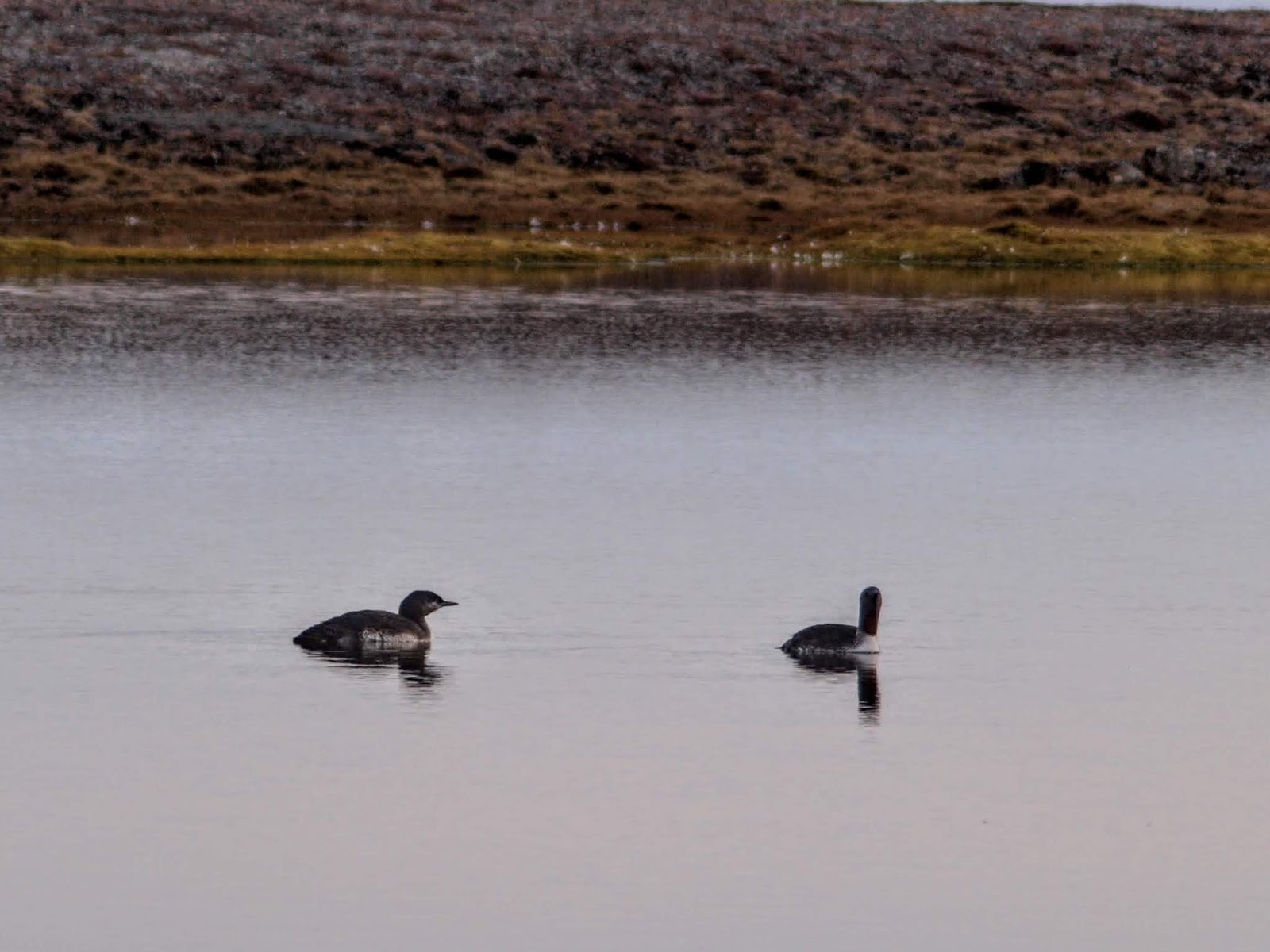
Red-throated loons Dundas Harbour

Sometimes we were in the zodiacs and the folks on the other side got a great view of the whales blowing while we had our backs to them. The drivers did a great job of trying to turn the boats around so that everyone got a turn but, again, the creatures didn't necessarily get the memo. There was much talk among those of us with cameras about how carrying a camera influenced the experience. Were we so busy trying to get the photo that we weren't paying attention to the rest of the immense expanse of sea and land that we were travelling through? One day I made the classic rookie mistake of not checking I had put the battery back in my camera after charging it the night before. I've often wondered how people could be so stupid as to do that. I found it was much easier than I thought! When I realized what I'd done I shrugged, put the camera in my backpack and took out the binoculars. There was a kind of relief in not having to dodge heads to try and capture a moment. I had my cell phone with me and I did use that when a wide angle made sense. 

Whale tail
Not sure what kind of whale
There were times when my longest lens wasn't long enough to show more than black dots for a whale's tail so I put the camera down and enjoyed the show through the binoculars. We saw humpbacks, belugas, killer whales, and narwhals. What was just as cool as seeing them was hearing them blow and seeing the spray as they did so. The narwhals were exfoliating on a gravel beach so we had quite a bit of time to observe them. Again I didn't manage to get photos but two people spotted one male with a tusk. I came away with a new respect for the patience and tenacity of wildlife photographers.


Fulmar
More fulmars
There were many many different species of birds, most of which looked like gulls to me. I had hours of fun chasing them with my lens and looking at them through binoculars and, again, got very few good photos. On our way to the viewpoint for the Ilulissat Glacier we saw an Arctic fox running across the tundra. Twice people spotted a mother polar with cubs on an ice flow. We also saw two solitary male bears, one on land and one on an ice flow.

Thick-billed murres in flight
Our zodiac group was extremely lucky in that we got to cruise near a bird colony before the fog rolled in. The second zodiac group didn't get that chance because the fog was too thick for them to launch. I fell in love with the thick-billed murres, “penguins of the Arctic.”
They aren't actually penguins, being members of the auk family but they are black and white, have small stubby wings and look a bit like penguins. You have to give them full marks for effort in the flying department. They are anything but graceful whether taking off, landing, or flying.
It was a tough take-off!
Nesting on the cliff
One ornithologist said they are the bumblebees of the bird world: they shouldn't be able to fly but no one told them that. They are, however, expert divers. They can reach a depth of 150m and stay down for up to 4 minutes at a time. They use their wings to swim underwater. Pairs lay one egg directly on rocky ledges and the parents actually become slightly anorexic while feeding the chick. Lower body weight means they can fly farther in search of food. When the chick is ready to fledge, Dad goes into the ocean and calls to the chick. The chick eventually leaps off the ledge and splashes down beside the him. Murres spend most of their lives in the sea and the chicks' first migration is accomplished in the water. These birds delighted me no matter what they did. I couldn't help but laugh at the way they would fly close to the surface of the water and then crash-land into it.

Seal
Seals weren't a common sight but we did see them several times. We didn't see walruses. Apparently, that's not entirely bad because you can smell them before you are close enough to see them very well and the smell is unique and overwhelming. I think I'm okay with not being able to tick the box beside walrus.
Another seal

My eyes are telling me I've had enough screen time for the present so I'll leave it there. While I'm out of the shop I'll spend some time going through Richard's photos and perhaps he'll let me use a few of his to augment the ones I took. Some of mine are pretty grainy, apologies for that. The camera is 8 years old with  a 10 megapixel sensor and no image stabilization. Do I have camera lust? Yup.


Sunday, September 23, 2018

White paint and patience


     Okay so this isn't the third in the series of Arctic trip posts but I'll get back to them, I promise. This morning at 6:30 my eyes popped open and I couldn't get back to sleep. (Stop laughing all of you larks who love to mock my night-owl ways!) I lay there for a while and had a lovely think which usually sends me right back to sleep. Not this morning. After about an hour I decided to get up and make some tea. I thought about writing a blog post and then realized I was a bit chilly and what I really wanted was to put on the puffy vest I bought aboard the Ocean Endeavour this summer. The vest was downstairs sitting on the desk beside the sewing machine.

     It's a bit of a story. I've discovered that aboard a ship the crew is always painting something. I don't think there was a single day that passed that I didn't see a crew member, paintbrush in hand, touching up railings or trim or something. Most of the time there were signs posted or areas were roped off, that is unless you happened to inadvertently get into an area you weren't supposed to be in. There were sliding glass doors on either side of the reception area which led to the stairs when the ship was docked. When the ship wasn't docked the stairs (gangway?) were stowed but you could still get out the glass doors. I had seen other people out there admiring the ice as we went on our way and I was in need of some fresh air so I went through the automatic doors and onto the small platform.
     I took some photos and, when I'd had enough fresh air, turned around to go back into the ship. Nothing happened. I waved my arms around, tried standing in different places. Still nothing happened. By this time I was getting a wee bit chilly and I also felt pretty stupid. There were people roaming around on the inside of the ship so I tried to get someone's attention. No luck. I didn't want to knock loudly on the glass and attract everyone's attention. I just wanted one kind soul to notice me and walk towards the doors so I could get in. Knocking on the glass was definitely an option but I decided before I did that I would try to see if there was another way in.
     I left my post by the door and walked toward the bow. Dead end. I walked back to the door and walked toward the stern. This was a bit trickier since the gangway was folded up and there wasn't much space between it and the side of the ship. I went as far as I could to another dead end. On the way I must have brushed against something. I went back to my station outside the glass doors and before I could knock, someone stepped into the magic zone that opened the doors for me. I walked inside trying to look nonchalant. No one took particular notice.
   After dinner that night I noticed there was something white on my vest. It didn't seem to want to brush off. No worries. I'd wash it out in the basin and all would be well in the morning. Nope. The substance on my vest wasn't coming out. When the vest was wet it looked hopeful but as it dried the white splotches where still there. I tried again when I got home pre-soaking the stain first. No luck. It must be white paint and the only place I can think of picking that up was on my little adventure outside the glass door.
     When I was in the library in Pond Inlet I picked up a patch to sew on my pack. It was bigger than most of the other patches and I wasn't sure where I'd put it. When I realized the stain wouldn't come out of the vest, I tried the patch to see if it would cover the white marks. It did so I pinned the patch on and then got distracted by something else and left the vest by the sewing machine. This morning when I was debating about what to do I decided it would be a good time to sew on the patch.
     As with most things the process wasn't straightforward. The patch needed to be sewn on above a pocket so I had to be careful to just catch the top layer of fabric. Also patches are nasty tough things and hand sewing isn't my favourite indoor sport. I started in, had to pull out several stitches several times and eventually got the patch on the vest. The house was quiet and as I sewed I thought about building the ukulele. How many times did I have to redo things? How many times did things actually got smoothly? Now many repairs have gone into it so far? I realized that I wasn't cranky when I had to pull out stitches. If I wanted the patch to lie relatively flat I had to fix the mistakes when I noticed them. It would take the time it would take.
     I don't know if I was a patient kid. I've long known I have patience for some things and not for others. What I realized this morning is that, on a good day, I can be patient when my usual response is irritation. On a good day...

Sunday, September 16, 2018

They did what on a snowmobile? Arctic adventure #2


This shows the area we were in
The colours in Sisimiut
This summer we decided to pull out all the stops and take back-to-back trips with Adventure Canada. The one we took in 2015 to Newfoundland and Labrador was to have been a once-in-a-lifetime trip. We really liked it and we're getting to the age where it's better to do things now than later so off we went. The first trip was called an Arctic Safari and we were to visit places in Greenland and the Canadian North where there was a possibility of seeing wildlife. The second trip was Into the Northwest Passage and we hoped to visit the Franklin graves on Beechy Island as well as the national historic site that marks the wrecks of the HMS Erebus and HMS Terror.

I left off with us sailing up the coast of Greenland and I'll pick it up there. We visited the town of Sisimiut twice, once on the Arctic Safari and once on the Into the Northwest Passage trip. The first time it was overcast and grey and the second time it was sunny. We were warned about people in Greenland being crazy drivers but there wasn't very much traffic and I didn't see anything that I'd call crazy. We did try to walk on the sides of the roads and not be stupid pedestrians.
We wandered around town, took photos and on our first stop there Richard and I both bought neck tubes made from muskox wool. They are very soft and very warm. I have a pair of socks that a friend gave me years ago and they travelled with me on this trip so both ends were warm thanks to the muskox.

I decided to go right back to the basics of photography by setting the camera on manual and shooting only in that mode. It was very instructive and, in a way, much simpler than learning what to do with all the whistles and bells on the contemporary cameras. If you like what's in the frame take the picture. If it's too light or too dark change one of the settings. I can't quite do that at lightning speed but it really helped me to make better choices rather than just setting the thing on auto.
We enjoyed the bright colours of the buildings in Greenland and found out that originally there was a colour code. Government buildings and the houses of government workers were painted a certain colour (can't remember which colour was which). Fishermen's buildings were another colour. It made for a good deal of visual interest against the grey sky.

The lake on the first visit
When we returned to Sisimiut for a second visit the sun was shining and the folks from the town were getting ready for snowmobile races. Yes, August and snowmobile races – on a lake – that wasn't frozen over! 
I couldn't imagine a snowmobile skimming across the surface of the water and was convinced they would get a few feet from shore and then sink. I was wrong. I hate to even think how the drivers got good at this but most of the ones we saw successfully remained upright as they took off from one end of the lake, drove to the other end, went around an orange buoy and then raced back and up onto the shore. 
This guy got a little cocky

We had to go back to the ship before the actual races began but it was a blast watching the two or three guys scoot around the lake in preparation for the real deal. I think they may have decided to take a spin because of the preponderance of 'blue penguins'* that lined the shore.

This is the result
The atmosphere was festive and we found a a good lookout spot on a rocky outcrop. As time passed more and more of the local people showed up. Some had coffee with them; others looked as though they had brought a picnic. There were lots of little kids and it was clearly a family affair.

Getting ready to roll
On both occasions in Sisimiut we were treated to a demonstration by a championship kayaker. It was incredible the number of ways he could roll the kayak. He did it with the paddle behind his head, with one hand on the paddle, with the paddle held against the hull of the kayak and at one point he did five rolls in quick succession. He wore a dry suit but had no gloves and his face was bare. I found out later that each kayaker usually makes his own kayak and that they are custom fitted so that water stays out and the kayak becomes a physical extension of the paddler. Although the covering materials have changed the kayak frames are still laced together. The wooden frames are covered with either canvas which is then oiled or nylon fabric which gets a coat of polyurethane. The Inuit used to salvage driftwood that washed up in order to build frames.

And under he goes!
On our first visit there was another cruise ship in the harbour. I got chatting to one of the guys travelling on it. According to him the ship had scraped an iceberg and divers were below checking the hull. I didn't get any more details than that and I wonder still what the whole story was.
I'm not sure how to end this elegantly so I guess I'll fill you in on the blue penguins and then stop. In the hotel in Ottawa one of the staff told us that we could recognize Adventure Canada staff by their white shirts and their black vests, kind of like penguins. Later when we were in a zodiac and a number of us had already landed, our driver commented that all the blue expedition jackets must be blue penguins. The name stuck.
Stay tuned. I'm not sure what I'll tackle next but I do want to get the trip recounted while it's relatively fresh in my mind. The organization may be a bit ragged. Luckily I'm not doing this for a grade. ;-)

Friday, September 14, 2018

Where have all the photos gone? Arctic Adventure #1


View from RCGS lunch
Where have all the photos gone? I'm not actually sure. Are they on my computer, in the Google cloud, in my camera, on my phone? That is partly why I haven't written a blog about the fabulous summer in the Arctic. I'm far from organized but I must start somewhere or I'll never get anything written or get any photos posted. This series of posts isn't going to be a chronological record but I will start at the beginning and try to pull a few photos from the pile.
Time for heavy clothes


We flew to Ottawa on Sunday August 5 expecting to spend the night and then fly to Resolute where we would meet the ship Ocean Endeavour to start our adventure. The adventure actually began in the hotel on Sunday night. Matthew James Swan our expedition leader welcomed us and gave us a quick lesson on ice charts. I'd never heard of ice charts before and I would say I'm quite familiar with them now. They are put out every 24 hours by the Canadian Ice Service and they ruled our lives for the month we were on Ocean Endeavour. On July 25 the passage into Resolute was completely clear. After that date the pack ice drifted in and choked the entrance. We were not going to Resolute. The ship had turned around half way across Baffin Bay and was heading back to Greenland. Thinking about the logistics of returning to Greenland made my head spin and for the first of many times I was extremely grateful that someone else had to handle the details.
Ocean Endeavour was hosting the “Students on Ice” program and the students had expected to get off the ship in Resolute and the fly from there to Ottawa on the planes we were planning to fly in on. Also, Resolute was to have been the resupply point for the ship. I don't know how all of this got worked out other than many people with a lot of experience worked many hours.
Our plane to Greenland
Our charter flights had to be cancelled and another carrier found who could, within 36 hours, get the proper paperwork for an international flight from Canada to Greenland. The company that managed to organize that was Sunwing. We all had a good laugh at the irony of that name.
In order to get everything arranged our departure was delayed. We were to spend Monday in Ottawa and fly overnight to Greenland. Suddenly Adventure Canada had over 200 people in Ottawa for a day and needed to do something with them. We had to vacate our rooms at noon and members of the Adventure Canada took turns babysitting our luggage during the day while we went on guided tours. In the morning we went on walking tours then were bused to The Royal Canadian Geographical Society for lunch. In the afternoon we went across to Hull to visit the Museum of Civilization and then back to the hotel for dinner. After dinner we changed into our warm clothes (Did I mention it was in the high 30's in Ottawa?) and boarded buses for the airport where Mother Nature gave us another taste of what we were in for. There was a wild thunder storm and all planes were grounded until it passed. The commercial flights had priority so we spent 4 hours in the airport before we were able to board the planes and take off. We arrived in Kagerlussaq at around 7 a.m. I got a bit of sleep on the plane but not much. We boarded buses and cleared Greenland customs. One official boarded each bus and walked down the aisle looking at our passports. When all was in order we drove to the dock transferred to the ship via zodiacs. 
Looking back at the dock in Kangerlussaq
Breakfast was waiting for us on the ship but before we could get underway there had to be a a boat safety drill. We ate breakfast and zombie-like followed instructions about lifeboats and lifejackets.We managed to get the lifejackets on and then off and when the drill was finished we went to our cabins for a few hours of shut-eye as the ship sailed up the coast of Greenland to Sisimiut. So ended the first lesson in Arctic travel: you may have plans but the wind, waves, and ice may have other ideas and it behoves you to pay close attention!